-Br Anthony Maria Akerman, O.P.
William Haun’s new book, Not to Caesar but to Peter, enters the ongoing American Catholic debate over the proper relation of Church and State. Haun is largely sympathetic to the integralist position, especially in his defense of a strong Catholic culture and a return to traditional disciplines that uphold a distinctly Catholic identity within the broader culture. His proposal does, however, separate him from integralism in some key ways.
“No one can, without risk to faith, foster any doubt as to the Church alone having been invested with such power of governing souls as to exclude altogether the civil authority. In truth, it was not to Caesar but to Peter that Jesus Christ entrusted the keys of the kingdom of Heaven.”1 The argument Haun advances is that integralism generally, and the work of Adrian Vermeule in particular, violates this God-ordained division of labor between the Church and the State.
Legal Pluralism
The majority of the book does a fine job tracing the political history of Christendom (chapters 1-3) and then of Catholicism in America (chapters 4-6). The story Haun tells, in brief, is of the Church’s coming to understand herself as a societas perfecta with her own genuine legal authority, although the Church in recent decades has often downplayed the notion that she is a societas perfecta. A key concept that Haun advocates is legal pluralism, a term borrowed from Harold Berman, meaning “the coexistence and competition within the same community of diverse jurisdictions and diverse legal systems.”2 Rather than advocating for more direct Catholic influence in the State, Haun argues the Church ought to reassert her status as societas perfecta and therefore her authority as a legitimate sovereign, which even the State ought to recognize.
After the fall of medieval Christendom, characterized by legal pluralism, there arose in its place what Haun calls “monistic secular sovereignty,” wherein “all legal power in a political community—including on religious duties” belongs to the secular state. In the face of this, the Church must reassert her exclusive competence in the direction of religious duties. On Haun’s reading, this is the message articulated by both Leo XIII and the Conciliar Fathers in Dignitatis humanae.
This project was once largely effective in the United States, as the Church in America focused on building up distinctly Catholic institutions and accumulating soft power to secure her own liberty, rather than trying to exert direct power over temporal governance. Unfortunately, by the mid-20th century, the Catholic Church, perhaps out of a greater desire for assimilation, gave up much of her cultural distinctiveness. In so doing she reduced herself to a voluntary association of individuals. And so the conception of the Church as a legal authority and a true spiritual sovereign, a societas perfecta, has been lost among most Catholics, especially in the United States.
In the seventh and final chapter, Haun moves from legal history to polemics, concluding his narrative with a critique of integralism, specifically of the project that Adrian Vermeule proposed as “integration from within.” Haun levels a charge frequently brought against integralism: that although it claims to subordinate temporal power to spiritual authority, in practice it enables a modern Gallicanism or Caesaropapism, ultimately subordinating Peter to Caesar.
Integration from within is modeled on biblical heroes like Joseph, Daniel, and Esther, who, placed by God into critical positions of influence and leadership, were able to steer great empires toward an inspired vision of the common good. Haun, by contrast, proposes what he calls “integration from without,” that is, building bottom-up Catholic “ministates,” intentional local communities that transform culture organically. Under Haun’s legal pluralism, the Church and the State can function as dual sovereigns without one usurping the authority of the other. By contrast, Haun thinks Vermeulian integralism usurps the Church’s exclusive jurisdiction in religious matters and creates legal precedent that can too easily be wielded against Catholics. In what follows I will consider these two criticisms in more detail.
Does the State have competence in religious matters?
The first question, then, is whether and to what extent the temporal power has any authority in religious matters.
Leo XIII clearly taught that the State has an inherent and inalienable “care of religion.”3 The same pope wrote elsewhere: “Justice forbids, and reason itself forbids, [the State] to be godless, to fall into atheism, or to treat the various so-called ‘religions’ alike, and to promiscuously bestow upon them equal rights and privileges.”4
At times, Haun is willing to acknowledge a relatively proactive role for the State in making necessary distinctions among religious groups. He admits outright, for instance, that Satanists are not actually pursuing the duty of religion and are thus not entitled to religious liberty as defined by Dignitatis humanae. By Haun’s own reading of the Conciliar declaration, it is the right and duty of the State to curtail pseudo-religious practices that are contrary to the natural law. If so, should he not add atheism, polytheism, idolatry, superstition, and blasphemy as contrary to reason and the natural law, and thus within the State’s jurisdiction to suppress? He even goes so far as to say, following Leo XIII, that “the Church’s claim to be the one, true Church founded by Christ is not a theological claim, but a claim of natural law.”5
But if this is true, then his accusation against the integralists that they concede too much spiritual competence to the temporal authority falls flat. For even if the State’s authority is limited to matters of the natural law, this would not prevent it from promoting Catholicism, legislating in light of her moral teaching, and even curtailing public expressions of religion that are contrary to the common good. Is this anything other than integralism?
What he repeatedly denies is that the State possesses any authority whatsoever to “direct religious duties.” This comes directly from Dignitatis humanae: The State “must be said to exceed its limits if it presumes either to direct or to impede [dirigere vel impedire] religious acts.”6 Haun interprets this to refer to “the power to set forth truths bearing on the supernatural and enforcing those efforts with the Church’s own code of law.”7
If the terms are defined carefully, none of this is problematic. The State has no magisterial authority, and no inherent rights over matters of Church governance. Similarly, canonical crimes are not under the jurisdiction of the State. To give a concrete example: the State would have no authority to designate a day as a holy day of obligation or a day of mandatory penance. However, once the Church has determined such things, the State can—and should—conform its own legislation to promote these observances. Indeed, the Catechism of the Catholic Church presently calls for the State to do just this.8
While it would seem that on this point both sides could agree, Haun frames what should be common ground as a critique of Vermeule:
Integration from within permits the rejection of Christ vesting all legal power to direct religious duties into the Church, and instead permits lay Catholics to act as if the state retained a native authority to suppress false religion without the Church’s permission.9
Regarding the latter charge, as we have just seen, Haun himself could be accused of the same. On his own reading, Dignitatis humanae authorizes the State to regulate religious practice according to the natural law and for the sake of the common good. As for the accusation that Vermeule rejects the Church’s exclusive power to direct religious duties, Haun provides no evidence. Indeed, he cannot. What Vermeule proposes in no way allows the State to usurp the Church’s determinative legal competence in religious matters. Rather he is upholding what Leo XIII taught to be the inherent rights and duties of the State, considered as such.
In this respect, Haun’s critique of Vermeule fails in quite the same way as Kevin Vallier’s attempt in All the Kingdoms of the World.10 Rather than engaging what he has written, the critics worry about what Vermeule secretly and nefariously intends. Haun admits in a number of places that if we take Vermeule at his word, then, he says, “I agree,” and that Vermeule “sounds right.”11 But the criticisms begin when it comes to what he fears Vermeule and the integralists might be thinking: “If that is all they desire, then I see that as unobjectionable. … Yet it seems like integration from within desires something else.”12
It is regrettable that debates about integralism often proceed as if the thesis being advocated is that Credobaptists or Monothelites ought to face capital punishment. What is being sought is the promotion of the integral common good of our society. This could mean things like closing businesses on Sunday, curtailing blasphemy and banning public obscenity, defending the truth and inviolability of marriage, and promoting public and civic expressions of faith and piety.
Haun appears largely agreeable to this project. His truest opposition to Vermeule, then, is not about ends but means.
What if the Roles were Reversed?
This brings us to the second major criticism of Vermeule, that integration from within concedes too much power to the administrative state, power that could just as easily be used to persecute Catholics. Sadly, for all of Haun’s well-founded criticisms of liberalism, here he remains entirely constrained by liberal presuppositions. For example, Haun approvingly quotes Archbishop Hughes as saying, “While it is the Catholics today, it may be the Universalists, or the Jews, or the Baptists, or the Unitarians tomorrow who may suffer.”13
This argument holds a certain prima facie plausibility. Catholics have suffered discrimination in America for being the religion of immigrants and adhering to a faith that is contrary to American values. How can we then use the same argument against other groups? The difference is that Catholicism is true. The refusal to own this fact is simply conceding the debate to liberalism.
Haun wants to defend the Church as a societas perfecta and uphold her autonomy as a religious institution with her own body of law. However, what he calls “the Church’s idealized relationship with civil government” is not feasible under the U.S. Constitution. Under his more pragmatic proposal, the State must abstain from specifying who God is. Consequently, “religious institutions claiming authority to act on [God’s] behalf must be treated as making a plausible claim,” and these same institutions must “have the autonomy to direct the fulfillment of those duties on those that are governed by that institution’s claims.”14 In this way, the autonomy he desires for the Church ought to apply equally to Islam, Hinduism, and Mormonism. He claims that this perspective “makes for a dramatic improvement within the American constitutional tradition” because it escapes the individualistic view of religious liberty prevalent today.15
This approach has significant difficulties. First, as far as civil law is concerned, an individual is only bound to obey the dictates of his religious community insofar as he considers himself bound. In this respect, every church and religious community remains a voluntary society. Furthermore, should we concede the legal authority to other religious groups to govern U.S. citizens, even by way of compromise? The Church possesses inherent legislative power precisely as a perfect society ordered toward man’s eternal beatitude, not as a religious institution with the legal autonomy to direct her members. These other religious groups are by definition not societates perfectae, not having in themselves the means to reach man’s supernatural end. As such, they have no true claim to legislate, as does the societas perfecta that is the Church. If they claimed to legislate and bind the consciences of their members, it would be by virtue of something other than their status as perfect societies. Yet this reveals an inconsistency in Haun’s approach, who wants the Church to recover her self-understanding as a perfect society precisely in order that she might has the authority to govern her people in religious matters.
Haun acknowledges elsewhere that the State does have competence to “regulate religion” according to the natural law and for the common good. Yet when it comes to his description of the implementation of “legal pluralism” he sounds more like John Rawls than Leo XIII.
Integration from Without
Haun’s counter-proposal of “integration from without” means that rather than aiming to leverage the tools of the modern state to pursue the common good, which includes public morality and the religion of its citizenry, Catholics should be more interested in building up Catholic institutions and localist “ministates.”16 This was the project that American Catholics successfully undertook in the 19th century but abandoned in the 20th, to the detriment of both Church and society. In simple terms, Haun’s proposal is bottom-up rather than top-down.
All of his concrete recommendations are entirely agreeable. He suggests that on the local level, communities could revive Catholic cultural and civic identity by, for example, returning to the practice of Friday abstinence, promoting blue laws and public prayer, putting a St. Michael statue in front of the police station, or marking Good Friday as a state holiday.
The problem is that pursuing this strategy as one’s sole or primary political aim entirely undersells the vision of Pope Leo XIII that Haun claims to follow. It is true that Leo XIII praised the situation of the Church in the United States as obviously preferable to the harshly anti-Catholic and laicist states of Europe. But he was also clear in reminding American Catholics that we should not be lulled by the Church’s relative autonomy in America into thinking that this is the ideal arrangement of Church and State.17
Integration from within is often misunderstood as being primarily about the accomplishment of the Church’s mission and the extent to which she can and ought to have recourse to the assistance of the secular power. But the social magisterium of Leo XIII, in documents like Immortale Dei and Libertas, is not so much about the needs of the Church as it is about the inherent obligations of the State. The argument is not that the Church needs the State, rather that the State needs the light of the Gospel. States that try to govern without God or without reference to the law of God are failing in their most basic task of promoting the common good of the community. The State, as the State, quite apart from anything else, has a duty toward God to have “care of religion” according to the dictates of God’s own revelation. As Leo XIII himself put it boldly:
States cannot, without crime, conduct themselves as if God did not exist at all, or cast aside the care of religion as something alien and of no benefit, or adopt indifferently from among many varieties whatever religion they please. They are strictly bound, in worshiping the Divine Majesty, to adopt that custom and manner in which God Himself has demonstrated that He wills to be worshiped.18
This is nothing other than the “traditional Catholic doctrine on the moral duty of men and societies toward the true religion and toward the one Church of Christ,” advocated by the more recent Vatican Council.19 Haun does well to support an increase in Catholic influence at the level of local government, but to decide arbitrarily that this same type of “integration” should not happen at the national level is to subvert what Leo XIII taught to be the intrinsic duty of States.
Rather than accepting a false dichotomy between bottom-up localism and top-down governance—the catacombs or Constantine—the integralist tradition embraces both. There is nothing inherently wrong with the localist approach promoted by Haun and others like him. As Vermeule himself writes, integralism “wants to order the nation and its state to the natural and divine law, the tranquility of order, precisely because doing so is the best way to protect and shelter the localities in which genuinely human community, imbued with grace, can flourish.”
The disagreement only arises when the localists want to foreclose the possibility of Catholics working within the State, as it is, in order to pursue the integral common good of society. And in this way the liberal hegemony is only reinforced by its would-be critics.
The Cooperation of Caesar and Peter
The book derives its title from a passage in Leo XIII’s Sapientiae Christianae, where the pope writes, “No one can … foster any doubt as to the Church alone having been invested with such power of governing souls as to exclude altogether the civil authority. In truth, it was not to Caesar but to Peter that Jesus Christ entrusted the keys of the kingdom of Heaven.”20 The broader context of the same encyclical reveals the fullness of the Leonine position to be quite different from Haun’s proposal.
It belongs to the Church alone to “govern souls,” that is, to determine the manner of religious observances and thus ultimately to direct man to his eternal beatitude. This does not mean, however, that the State is left indifferent or neutral on the religious question. On the contrary, Leo XIII quickly clarifies: “The Church and the State both possess individual sovereignty…. It does not hence follow, however, that Church and State are in any way separated.”21
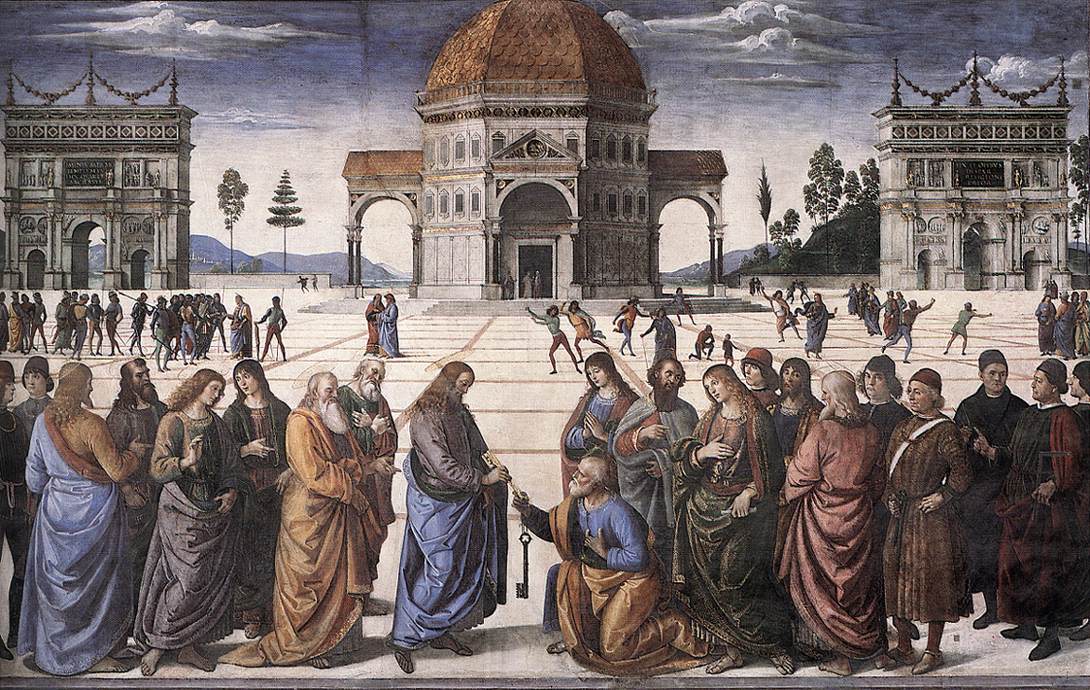
What Christ accomplishes in giving the keys not to Caesar, but to Peter, is not to separate spiritual and temporal authority, or otherwise to create a sphere of strictly secular governance. Rather, the giving of the keys reverses the former priority between temporal and spiritual power. This is wonderfully summarized in Saint Thomas Aquinas’s treatise De regno. The Angelic Doctor explains that religion is a natural obligation of man and of itself pertains to the common good of the temporal community. Thus before the coming of Christ (in both Judaism and paganism) the spiritual authority of priests was subject to the temporal authority of kings. However, when Christ reveals man’s vocation to eternal beatitude and establishes his Church on earth, this hierarchy is reversed. Whereas before priests were subject to kings, in the Messianic age kings are now subject to priests:
Thus, in order that spiritual things might be distinguished from earthly things, the ministry of this kingdom has been entrusted not to earthly kings but to priests, and most of all to the chief priest, the successor of St. Peter, the Vicar of Christ, the Roman Pontiff. To him all the kings of the Christian People are to be subject as to our Lord Jesus Christ Himself. For those to whom pertains the care of intermediate ends should be subject to him to whom pertains the care of the ultimate end, and be directed by his rule.22
Far too often the effect of Christ’s coming is misread as indicating that all care for religion is removed from the State. Not at all. Religion still pertains to the common good and temporal welfare of society, though this is no longer religion’s primary function. What this means is that the State, obliged as it is to have concern for the religious well-being of its citizens, must carry out this function in the light of and under the tutelage of the spiritual authority of the Church.
These obligations of the State are prior to any notion of “indirect power” or the Church deputizing the State to act on her behalf as her “secular arm.” As St. John XXIII has put it, “the common good is something which affects the needs of the whole man, body and soul.” Therefore, “States must take suitable measures to ensure” that, in the pursuit of the common good, they do “not jeopardize man’s eternal salvation; indeed, they must even help him to obtain it.”23
Integralism is not, as Haun suggests, a matter of surrendering spiritual authority to Caesar. Rather it is a recognition that the temporal power has inherent obligations “toward the true religion and toward the one Church of Christ.”24 Haun’s proposal can only partially fulfill this directive. He rightly asserts the truth of the Church as a spiritual sovereign. He even goes so far as to acknowledge that “a New Christendom” may well be the “ideal form of Church-state relations.”25 But in his attempt to reconcile the Leonine teachings on the duties of the State with the constraints of the American constitutional order, he errs in favor of the latter. Though his intention is to escape voluntarism and individualism, his proposal once again reduces the Church to the status of one jurisdictional claimant among many. Yes, Catholics can establish localized “ministates,” but so can every other group as well, and this notion of a “ministate” does not reflect the Church’s self-understanding as a societas perfecta. Such a ministate is obviously a power of a lower order, rather than one of a higher order.
By contrast, the Vermeulian strategy of integration from within retains the lofty ideal of Leo XIII without sacrificing political realism. Haun balks at this out of fear that it cedes too much authority to the State and threatens the Church’s proper liberty. Unfortunately, this worry leads Haun to become forgetful of the State’s God-given rights and duties with respect to religion.
- Sapientiae Christianae, 27. ↩︎
- William J. Haun, Not to Caesar but to Peter: Why the Catholic Church is a Perfect Society (Brooklyn, NY: Angelico Press, 2026), xvi; Harold J. Berman, Law and Revolution: The Formation of the Western Legal Tradition (Harvard University Press, 1983), 10. ↩︎
- Immortale Dei, 6. ↩︎
- Libertas, 21. ↩︎
- Haun, 171; cf. Immortale Dei 7: “It cannot be difficult to find out which is the true religion, if only it be sought with an earnest and unbiased mind; for proofs are abundant and striking.” ↩︎
- Dignitatis humanae, 3. ↩︎
- Haun, 2. ↩︎
- “In respecting religious liberty and the common good of all, Christians should seek recognition of Sundays and the Church’s holy days as legal holidays. They have to give everyone a public example of prayer, respect, and joy and defend their traditions as a precious contribution to the spiritual life of society.” Catechism, no. 2188 ↩︎
- Haun, xxv. ↩︎
- For example, Vallier at one point threatens: “When integralists abolish democracy,” Vermeule’s disciples will likely turn to, “execution, torture, and show trials.” He then adds, “Vermeule has publicly [denounced] all such tactics,” nevertheless, his writing “leaves one to wonder which tactics Vermeule has in mind.” Kevin Vallier, All the Kingdoms of the World: On Radical Religious Alternatives to Liberalism (New York: Oxford University Press, 2023), 147. ↩︎
- Haun, 193-194. ↩︎
- Haun, 200-201, emphasis mine. ↩︎
- Haun, 144. ↩︎
- Haun, 104. ↩︎
- Haun, 207. ↩︎
- Haun, 210. ↩︎
- “For the Church amongst you, unopposed by the Constitution and government of your nation, fettered by no hostile legislation, protected against violence by the common laws and the impartiality of the tribunals, is free to live and act without hindrance. Yet, though all this is true, it would be very erroneous to draw the conclusion that in America is to be sought the type of the most desirable status of the Church, or that it would be universally lawful or expedient for State and Church to be, as in America, dissevered and divorced.” Longinqua, 6. ↩︎
- Immortale Dei, 6. ↩︎
- Dignitatis humanae, 1. ↩︎
- Sapientiae Christianae, 27. ↩︎
- Sapientiae Christianae, 30. ↩︎
- De regno, XV, no. 110. ↩︎
- Pacem in Terris, 57-59. ↩︎
- Dignitatis humanae, 1. ↩︎
- Haun, 208. ↩︎