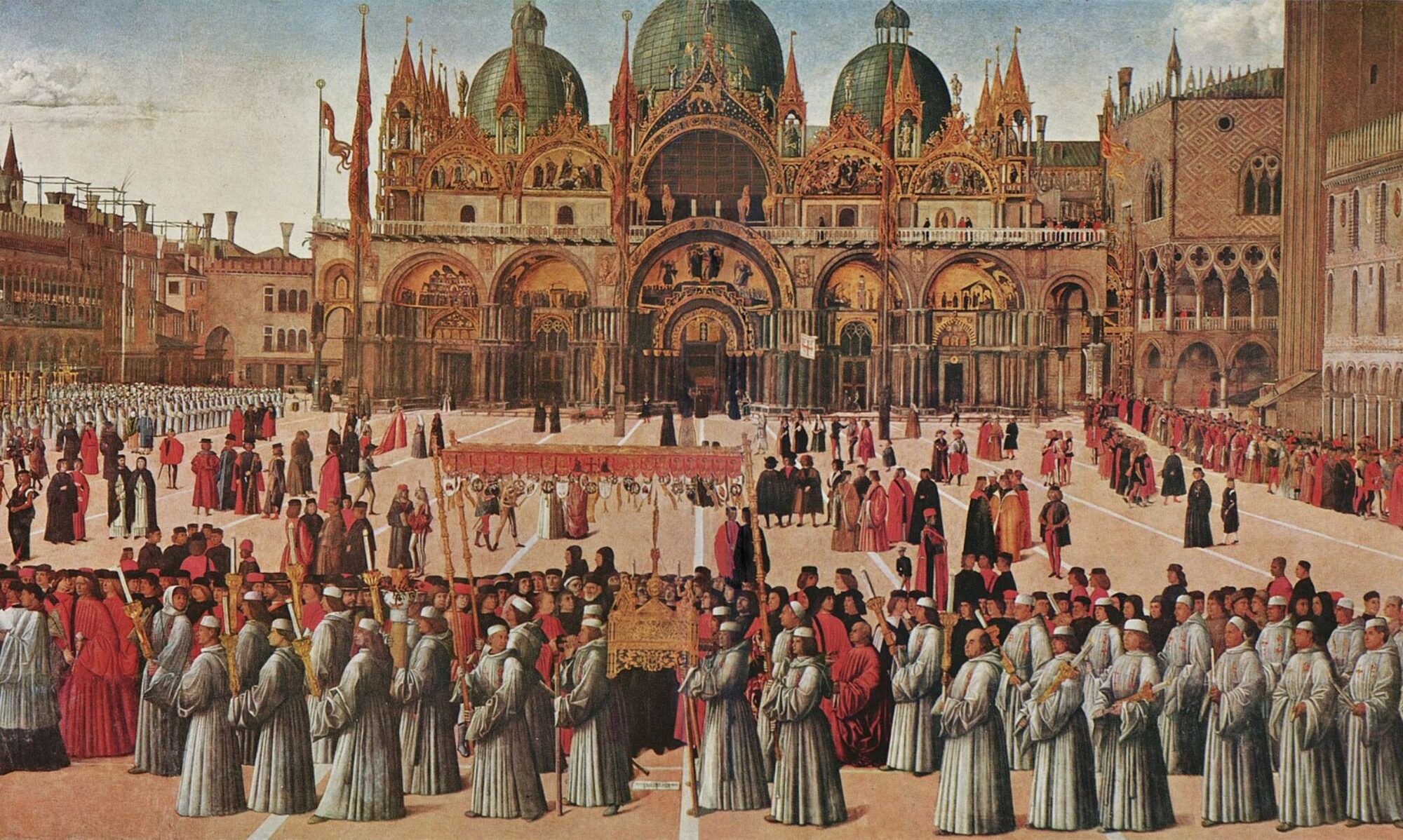
 The Josias is planning an online reading group to discuss Andrew Willard Jones’s new book, Before Church and State: A Study of Social Order in the Sacramental Kingdom of St. Louis IX. Jones’s book is perhaps the most important recent work on a subject of great concern to The Josias: the relation of spiritual to temporal power. Jones argues that the understanding of the relation of spiritual and temporal power elaborated in the teachings of the popes of the High Middle Ages has been imperfectly understood by historians. Historians have tended to place that understanding, and the conflicts in which it was elaborated, in the context of the narrative of the rise of the sovereign, national state. Jones argues that that narrative, in which conflicts between spiritual and temporal power in the Middle Ages are viewed as conflicts between the “secular” power of “the state” and the “religious” power of the “church” for “sovereignty” within society obscures the way in which medieval society actually functioned and understood its own functioning. In the Middle Ages, he contends, there was no such thing as “religion” or “the secular” in the modern senses of those words, there was therefore no such thing as “the church” in its modern sense of a voluntary association with purely religious aims, and there was no such thing as “the state” or the “sovereign” monopoly of power that characterizes that modern institution. Before Church and State is not only an insightful treatment of an historical period; it is also an important contribution to the proper understanding of perennial Church teaching on the relation of the two powers. Continue reading “Online Reading Group: Andrew Willard Jones’s Before Church and State”
Notes on Right and Law
by Petrus Hispanus
1. The words right and law refer to related realities. Their meaning is derived from the Latin ius and lex. The more fundamental of these is ius, as regards both the nature of the virtue of justice generally, and the juridical order specifically. In English, this is obscured by the predominance of the words ‘law’ and ‘legal’ to designate that order and the framework within which ‘rights’ exist. Continue reading “Notes on Right and Law”
The Object of the Moral Act
1. Acts are determined by their objects. The etymology of “object” suggests something thrown against. The object of an act is that against which or on which the act acts. The object of seeing is color. And color determines seeing; it makes seeing into the kind of act that it is. The object of hearing is sound, the object of eating is food, the object of nursing is a baby, the object of killing is a living thing. And in all these cases, the object determines the act, makes it to be the kind of act that it is, and gives it its nature. Continue reading “The Object of the Moral Act”
Dyarchy is Dyarchical: A Reply to Meador
Over at Mere Orthodoxy, Jake Meador has written an article outlining six responses towards mainstream culture and liberalism. Among these six, he prominently includes integralism as expounded upon in The Josias by writers such as Pater Edmund and E. M. Milco. Although Protestant, Jake Meador gives a sympathetic account of integralism as a coherent rejection of the current post-enlightenment liberal ordo, dominating western thought. Particularly valuable is Meador’s analysis of the reasons that not merely integralists, but also various other strains of Protestant and Catholic thinkers, are now having to grapple more deeply with the inherent contradictions of liberalism. Continue reading “Dyarchy is Dyarchical: A Reply to Meador”